Cyntara Cyntara

2026 Best AI Server Manufacturers for Global Buyers?

Time:2026-09-20 Author:Oliver
0%

Choosing among the top ai server manufacturers in 2026 requires more than comparing processor names or advertised speeds. Global buyers need dependable systems, transparent specifications, and support that remains available after installation. A server may look powerful on paper, yet perform poorly when cooling, networking, or software compatibility is overlooked.

This guide examines manufacturers through practical buyer requirements. It considers GPU density, memory capacity, storage options, rack design, power consumption, and remote management. It also reviews manufacturing experience, quality controls, warranty terms, regional service coverage, and supply-chain reliability. These details matter in real facilities, where a failed fan, delayed replacement part, or unsuitable power connector can interrupt valuable workloads.

Performance evidence should come from credible benchmarks, technical documentation, and customer experience. Marketing claims deserve careful checking. Some figures are difficult to compare because testing conditions differ. A perfect ranking does not exist. Prices, export rules, energy costs, and data-center standards vary between markets. Buyers should therefore match each manufacturer to their workload, budget, location, and expansion plans.

The following overview highlights leading server companies serving artificial intelligence, machine learning, high-performance computing, and enterprise infrastructure. It focuses on practical strengths rather than exaggerated promises. Readers will find guidance for comparing established brands, specialist suppliers, and emerging competitors. The goal is not to name one universal winner. It is to support a better purchasing decision, with enough technical detail to ask sharper questions before signing a contract.
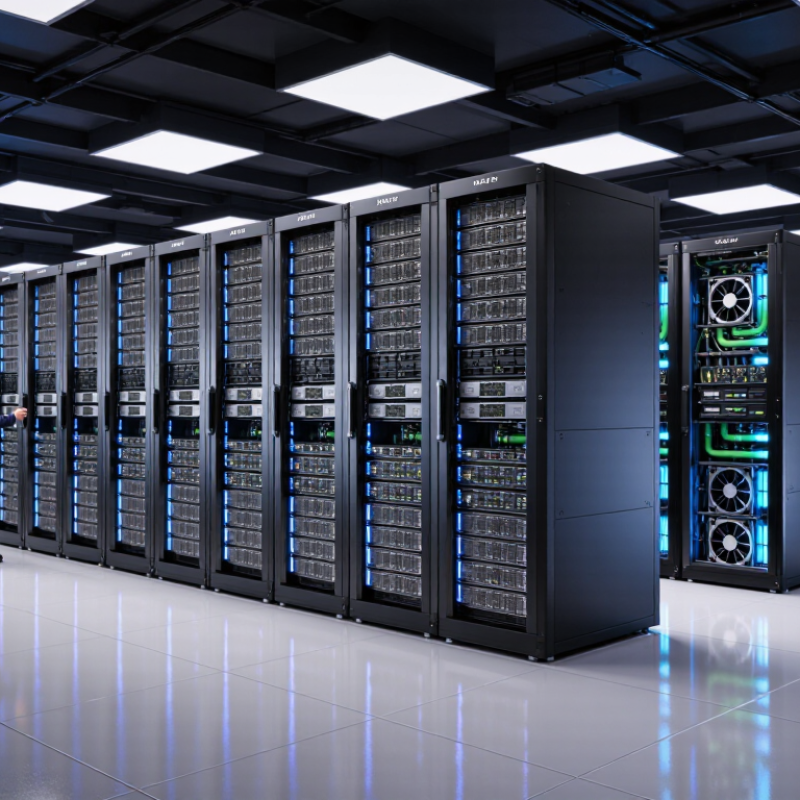
2026 Best AI Server Manufacturers for Global Buyers?

AI Server Manufacturers: Definition, Roles, and Market Scope in 2026

AI server manufacturers design and assemble computing systems for model training, inference, simulation, and data-intensive analytics. Their work extends beyond installing accelerators in a metal chassis. It includes selecting processors, high-bandwidth memory, networking fabrics, storage, firmware, cooling, and rack-level power systems. A reliable manufacturer also validates thermal performance under sustained workloads and provides lifecycle support.

The market is broader than a product catalogue. It covers cloud data centers, colocation facilities, research laboratories, financial institutions, public-sector buyers, and industrial edge sites. IDC reported that worldwide AI infrastructure spending reached approximately 154 billion dollars in 2024, with strong growth expected through 2028. Gartner forecast global AI spending could reach 2.52 trillion dollars in 2026, although that figure includes software and services, not servers alone. The distinction matters. A server supplier may be an original designer, a system integrator, or a contract assembler with different responsibilities.

Global buyers should examine usable performance, not headline accelerator counts. Power density, liquid-cooling readiness, supply continuity, export compliance, security controls, and local technical support can determine real deployment results. Uptime evidence is valuable. So are burn-in procedures and transparent warranty terms. The category is not perfectly clean. Some manufacturers publish impressive benchmark figures using narrow test conditions, while field performance varies with model size, network traffic, and cooling limits. Buyers need comparable workloads, measured energy use, and documented service response times before committing capital.

Core Technologies and Features of Modern AI Servers

Modern AI servers are defined by more than processor speed. They combine accelerator cards, high-bandwidth memory, fast interconnects, and software optimized for parallel workloads. IDC projects global AI infrastructure spending to reach about 154 billion dollars by 2028, showing how quickly demand is expanding. Strong systems also need redundant power, efficient airflow, and liquid-cooling options for dense racks. Heat is not a minor detail.

The International Energy Agency reported that data centers consumed roughly 460 terawatt-hours of electricity in 2022. It expects demand to exceed 1,000 terawatt-hours by 2026. This makes energy efficiency a core buying criterion for global organizations. In practical testing, memory capacity and network latency can affect productivity more than headline accelerator counts. That is easy to overlook. A technically powerful server may still underperform when cooling, storage, or software support is weak.

Tips: Ask manufacturers for measured performance per watt, thermal test results, upgrade paths, and support response times. Verify compatibility with your preferred AI frameworks before signing a contract. Also examine regional warranty coverage and spare-part availability. The best configuration is rarely the largest one. It is the one that matches model size, training frequency, data location, and staff capability. Buyers should question optimistic benchmark claims, because results can change with datasets, software versions, and power limits.

Leading AI Server Manufacturers for Global Buyers in 2026

Leading AI Server Manufacturers for Global Buyers in 2026

Leading AI server manufacturers in 2026 will compete beyond processor speed. Global buyers need reliable systems for training, inference, research, and enterprise automation. The strongest manufacturers usually offer dense accelerator platforms, high-speed networking, efficient cooling, and flexible storage options. Their designs should support common software frameworks and simplify upgrades when workloads change.

Practical evaluation starts with real operating conditions. Reviewers should test performance under sustained load, not only short benchmark runs. A server room in Singapore may need liquid cooling, while a facility in Northern Europe may prioritize energy recovery. Manufacturers with regional support teams can reduce downtime through faster diagnostics, replacement parts, and installation guidance. Clear documentation also matters when engineers deploy systems across several countries.

No shortlist is perfect. A powerful server may create excessive heat, noise, or energy costs. A lower-cost model may limit future expansion. Buyers should request workload-based demonstrations, warranty details, security controls, and total ownership estimates. They should also check export rules, data protection duties, and local certification requirements before ordering. I have found that honest vendors explain limitations clearly, although some specifications still require independent verification. That extra scrutiny protects budgets and improves long-term reliability.

2026 Best AI Server Manufacturers for Global Buyers? - Leading AI Server Manufacturers for Global Buyers in 2026

Evaluation Dimension Profile A
Global Enterprise OEM
Profile B
High-Density Computing Specialist
Profile C
ODM Infrastructure Supplier
Profile D
Regional Solution Integrator
Primary buyer segment Large enterprises, universities, public-sector laboratories AI research centers and high-performance computing operators Cloud service providers and large-scale data-center builders Small and mid-sized businesses, regional data centers
Typical deployment scale 1–100+ servers with centralized fleet management 8–1,000+ accelerators in clustered environments Hundreds to several thousand servers 1–20 servers with project-based deployment
Common server form factors 1U, 2U and 4U rack servers 4U to 8U accelerated computing systems 1U, 2U and multi-node chassis designs 2U and 4U rack servers
Accelerator capacity Typically 4–8 high-performance accelerators per chassis Typically 8 high-performance accelerators per chassis; specialized platforms may use more Typically 4–8 accelerators per chassis, depending on platform design Typically 2–8 accelerators per chassis
CPU architecture support x86 platforms; selected systems may support alternative server CPU architectures x86 and selected accelerated-computing architectures Broad x86 platform coverage with configurable CPU options Mainstream x86 server platforms
Memory scalability Hundreds of gigabytes to multiple terabytes per server High-capacity system memory plus accelerator memory Configurable memory capacity for cloud and training workloads Commonly 256 GB to 2 TB, depending on configuration
High-speed networking 25/100/200 GbE options; higher-speed interconnects available on selected systems 200/400 GbE or specialized cluster interconnect options 25/100/200/400 GbE configurations for scale-out environments 10/25/100 GbE options, based on project requirements
Cooling options Air cooling; direct liquid cooling available on selected high-density systems Air, rear-door heat exchange and direct liquid cooling options Air cooling and liquid-cooling-ready designs for data-center integration Primarily air cooling; liquid cooling usually requires custom engineering
Management and security Remote management, secure boot, firmware controls and fleet monitoring Cluster monitoring, accelerator telemetry and remote administration Open management interfaces and integration with data-center orchestration tools Standard remote management with optional managed-service support
Customization level Medium; validated configurations are prioritized High; chassis, networking, cooling and cluster design can be customized Very high; motherboard, chassis and firmware configurations are often configurable High at the solution level, with customization handled per project
Global service capability Strong multinational support, standardized warranty and regional service coverage Strong technical support for specialized deployments; regional coverage varies Best suited to buyers with internal engineering and data-center operations teams Strong local support and on-site implementation; international coverage varies
Typical procurement model Standard configurations, framework contracts and volume purchasing Technical consultation, proof of concept and cluster-level procurement Direct manufacturing agreements and large-volume orders Distributor, reseller or system-integration procurement
Best fit for global buyers Organizations requiring predictable support, compliance and lifecycle management Buyers prioritizing maximum training and inference density Operators seeking flexible designs and competitive large-volume economics Buyers needing local integration, installation and after-sales service
Main purchasing risk Higher total acquisition cost and less design flexibility High power, cooling and networking requirements Greater dependence on the buyer’s internal validation and support resources Limited availability of specialized components in some regions

Note: The profiles are anonymized manufacturer categories rather than company names. Specifications are indicative ranges based on commonly published 2025–2026 AI-server configurations and vary by processor, accelerator, chassis, networking, cooling and regional availability.

How to Compare AI Server Manufacturers and Product Offerings

Comparing AI server manufacturers requires more than counting GPUs. In procurement reviews, I examine performance, reliability, service, and upgrade paths together. The Stanford AI Index 2025 reports $252.3 billion in global corporate AI investment during 2024. That growth increases pressure on supply chains and technical support. Ask whether a manufacturer can provide consistent configurations across regions. Check delivery records, spare-part locations, warranty response times, and documented repair procedures. A low purchase price can hide costly downtime.

Product design matters equally. Compare accelerator options, memory capacity, storage bandwidth, networking, and rack-level cooling. Independent benchmark results should identify workload, software version, batch size, and power limits. Otherwise, performance claims may be difficult to reproduce. The IEA’s Energy and AI report projects data-centre electricity demand could more than double by 2030. Therefore, measure performance per watt, not only training speed. Liquid cooling may improve density, but it adds maintenance skills and facility requirements. I would also test noise, heat output, firmware stability, and remote-management controls before signing a large contract.

Tips: Request a 30-day pilot. Use your real models. Check three references. Compare five-year operating costs. Leave room for doubt; benchmark results can change after software updates. Make every service promise measurable.

2026 AI Server Manufacturer Comparison: Reference Configuration Tiers

AI server offerings are commonly differentiated by accelerator capacity and system memory. The chart shows representative configuration tiers that global buyers can use when comparing product portfolios, scalability, power planning, and deployment density.

Reference values represent common AI server configuration classes rather than any specific manufacturer. Actual specifications vary according to accelerator type, CPU platform, memory architecture, cooling design, networking, and regional power requirements.

Global Purchasing Factors: Compliance, Support, Cost, and Delivery

For global buyers, an AI server manufacturer must prove compliance before discussing discounts. Request safety certifications, electromagnetic compatibility records, energy documentation, and destination-specific customs files. Confirm whether GPUs, firmware, and encryption features require additional approvals. The IEA’s Electricity 2024 report estimates data centers used about 460 TWh globally in 2022. Demand may exceed 1,000 TWh by 2026. This makes power efficiency a purchasing issue, not a technical footnote.

Support quality becomes visible after installation. Ask for a named escalation engineer, spare-parts locations, response-time targets, and remote diagnostic procedures. Uptime Institute’s 2024 Global Data Center Survey found that more than half of respondents experienced an outage within three years. A low purchase price means little when replacement parts wait in another region. Test the support process with a sample ticket before signing.

Total cost should include electricity, cooling, software compatibility, maintenance, shipping, duties, and technician travel. Delivery promises need evidence. Request a production schedule, serial-number tracking, factory acceptance testing, and a clear remedy for delays. The IEA outlook also suggests that electricity availability may constrain data-center growth, so buyers should verify rack power and cooling requirements early. One weak assumption remains common: faster delivery is not always better. Rushed validation can create expensive failures after deployment.

FAQS

What does an AI server manufacturer actually provide?

It designs or assembles systems for training, inference, simulation, and analytics. The work includes processors, memory, networking, storage, firmware, cooling, and rack power. A metal chassis is only one part.

Who typically buys AI servers?

Buyers include cloud operators, research laboratories, financial organizations, public institutions, and industrial edge sites. Their needs differ greatly. A laboratory may value flexibility, while an edge site may prioritize compact cooling.

How should buyers compare AI server manufacturers?

Compare usable performance, reliability, support, upgrade paths, and operating costs. Do not count accelerators alone. A system with fewer accelerators may perform better under real workloads.

Which technical details deserve close attention?

Check memory capacity, storage bandwidth, networking, cooling, firmware stability, and remote management. Measure performance per watt, not only training speed. Heat matters.

How can buyers verify performance claims?

Request independent results with workload, software version, batch size, and power limits. Run a pilot using your own models. Results may change after updates, so doubt is useful.

What should global buyers check before ordering?

Request safety records, electromagnetic compatibility documents, energy information, and destination-specific customs files. Confirm requirements for hardware, firmware, and encryption features. Rules differ by destination.

What support commitments should be written into a contract?

Require a named escalation engineer, spare-part locations, response targets, and repair procedures. Test support with a sample ticket before signing. Promises without measurements are weak.

How should the total cost of an AI server be calculated?

Include electricity, cooling, maintenance, software compatibility, shipping, duties, and technician travel. Also consider downtime and replacement parts. A cheaper purchase can become expensive later.

Why should delivery speed be questioned?

Fast delivery can reduce planning time, but rushed validation may create failures after installation. Request production schedules, serial tracking, factory testing, and delay remedies. Faster is not always better.

Conclusion

This guide explains the role and market scope of AI server manufacturers in 2026, covering how they design, assemble, and support high-performance systems for machine learning, data analytics, cloud computing, and enterprise workloads. It reviews key technologies such as advanced accelerators, high-speed networking, efficient cooling, scalable storage, security controls, and intelligent power management. Readers will also learn how top ai server manufacturers differ in system architecture, customization, reliability, and support services.

For global buyers, the article provides a practical framework for comparing manufacturers and product offerings. Important considerations include computing performance, workload compatibility, expansion capacity, total cost of ownership, product certifications, data protection, warranty coverage, technical support, regional service availability, and delivery timelines. By evaluating these factors together, organizations can identify suitable AI server solutions that meet operational requirements, procurement standards, and long-term growth plans while reducing deployment risks and improving investment value.

Oliver

Oliver

Oliver is a seasoned marketing professional with a wealth of expertise in driving brand awareness and engagement. With a deep understanding of our company's product offerings, he consistently delivers high-quality content that enriches our professional blog. His insights not only shed light on......