Cyntara
The market for AI infrastructure is moving quickly, but choosing a server is still a practical decision. A strong ai computing server manufacturer must deliver more than impressive accelerator specifications. Buyers also need dependable power design, validated cooling, fast networking, and support that continues after installation. Small details matter: rack depth, cable routing, firmware updates, and whether a system can sustain full load without throttling.
This guide examines ten manufacturers relevant to AI deployments in 2026. It considers product range, accelerator options, system integration, service coverage, and the clarity of technical documentation. The right choice depends on the workload. A research lab training large models may prioritize dense GPU configurations and high-speed interconnects. An enterprise deploying inference may care more about efficiency, availability, and operating costs. There is no universal winner. No list can fit every lab.
Comparisons also have limits. Product availability, regional support, and component configurations can change during the year. Published performance claims should be checked against independent testing and the buyer’s own workload. A polished specification sheet does not reveal every operational issue. That is worth remembering. The manufacturers profiled here offer different strengths, and some may suit a particular deployment better than others. Use this overview as a starting point for due diligence, not as a substitute for testing, reference checks, and a clear total-cost estimate.
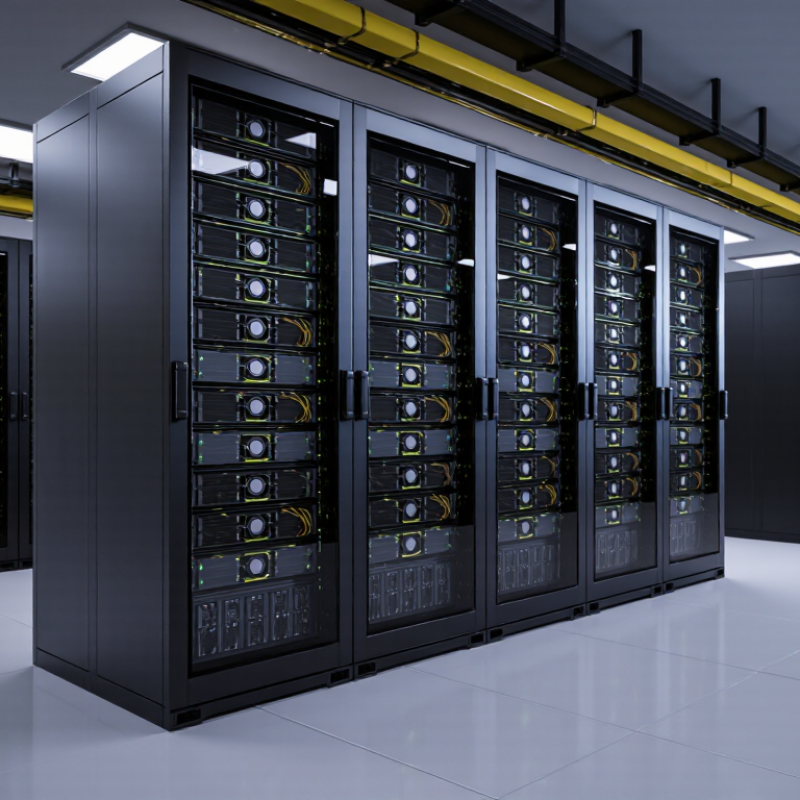
AI computing servers are designed for sustained parallel workloads, not a little of everything. Their accelerators process many calculations at once, helping train models and run large inference jobs. A general-purpose server usually balances web services, databases, and routine business applications. The difference is visible inside the chassis: accelerator cards, high-bandwidth memory, and faster links between processors often take priority. These parts draw substantial power. They also produce concentrated heat.
That changes the room around the server. AI racks may need stronger power delivery, liquid cooling, and fast networking to move data between machines. A general-purpose rack can often use conventional airflow and more modest power circuits. Yet bigger specifications do not guarantee better results. If data pipelines are slow, expensive accelerators may sit idle. Planning can overlook this detail; it is an easy mistake to repeat. Compare workload performance, power use, cooling needs, and service access, rather than counting cores alone.
Tips: Test with representative workloads before choosing a configuration. Check rack power and cooling capacity, including peak demand. Leave room for cable access and maintenance. If the workload is uncertain, a small pilot may reveal more than a polished benchmark.
Evaluating AI server manufacturers in 2026 means looking beyond peak accelerator counts. Ask for sustained workload results, measured at realistic rack power and temperatures. A system that performs well for ten minutes may throttle during an overnight training run. Check memory bandwidth, network latency, storage throughput, and compatibility with your existing software. Request test methods, not just headline scores. That matters.
Power and cooling deserve equal scrutiny. The International Energy Agency’s Electricity 2025 report estimates data centres used about 415 terawatt-hours of electricity in 2024, with demand potentially reaching roughly 945 terawatt-hours by 2030. Compare measured performance per watt, cooling requirements, and rack density under your site’s conditions. Also assess redundant power paths, component replacement times, firmware updates, and access to spare parts. Uptime Institute’s 2024 outage analysis found that more than half of respondents’ most recent significant outages cost over $100,000. Reliability is measurable, but no test is perfect. I would still question a vendor’s best-case benchmark until it is repeated with your workloads and documented operating limits.
The 10 leading AI computing server manufacturers in 2026 are best compared by more than accelerator counts. Buyers should examine memory bandwidth, high-speed interconnects, power efficiency, cooling design, and support for different workloads. A dense rack can deliver impressive performance, but only if a facility can supply its power and remove its heat. Small details matter: coolant connections, cable access, and service clearance can shape deployment time.
Demand is rising fast. Gartner’s 2025 forecast put worldwide AI spending at about $1.5 trillion that year, with spending projected to reach $2 trillion in 2026. The International Energy Agency’s Energy and AI report estimated data centres used around 415 TWh of electricity in 2024, potentially more than doubling by 2030. These figures make efficiency and thermal management practical buying criteria, not side issues. Look for transparent benchmark methods, validated workload results, and clear service commitments. No ranking is perfect. Some published comparisons underweight repairability and long-term operating costs, and those gaps deserve scrutiny before a purchase.
An anonymized comparison of common AI server portfolio capabilities. Configurations vary by model; this is not a ranked product specification.
| No. | Anonymized Manufacturer | Typical AI Server Portfolio | Accelerator Configuration Range | Cooling and Infrastructure | Common Deployment Fit |
|---|---|---|---|---|---|
| 01 | Manufacturer 01 | Rack servers for AI training, inference, and general-purpose data-center workloads | Single-accelerator systems through dense multi-accelerator platforms; 8-GPU configurations are common in this segment | Air-cooled options; liquid cooling available on selected high-density systems | Enterprise data centers seeking integrated server, storage, and support services |
| 02 | Manufacturer 02 | High-density GPU servers and rack-scale systems for large AI workloads | Multi-GPU nodes, including 8-accelerator configurations in supported platforms | Air cooling on selected models; direct liquid cooling offered for some high-power configurations | AI research, model training, and high-performance computing clusters |
| 03 | Manufacturer 03 | Configurable 1U–4U servers, GPU systems, and rack integration solutions | From compact inference configurations to multi-GPU training nodes, depending on chassis and platform | Air-cooled systems are widely available; liquid-ready designs depend on configuration | Organizations needing a broad choice of form factors and deployment options |
| 04 | Manufacturer 04 | Enterprise servers with accelerator options for AI, analytics, and virtualized workloads | Single- and multi-accelerator systems; maximum capacity varies by server family | Primarily air-cooled portfolio, with advanced cooling options on selected dense systems | Businesses prioritizing enterprise management, service coverage, and mixed workloads |
| 05 | Manufacturer 05 | AI-optimized servers and cluster components built around current accelerator platforms | Multi-accelerator nodes, with high-density configurations available for selected platforms | Air and liquid cooling options vary by server generation and rack design | Dedicated AI clusters and compute-intensive workloads |
| 06 | Manufacturer 06 | Customizable GPU servers, storage systems, and rack-level solutions | Configurations range from inference-focused systems to multi-GPU training servers | Cooling choices depend on the selected chassis, accelerator power, and rack specification | Cloud providers, system integrators, and organizations with tailored hardware needs |
| 07 | Manufacturer 07 | Data-center server platforms with GPU, networking, and storage choices | Single- to multi-accelerator systems; supported counts differ by platform | Standard air cooling plus selected high-density cooling configurations | General-purpose data centers expanding into AI inference or training |
| 08 | Manufacturer 08 | Rack-scale compute platforms designed for parallel workloads and cluster deployments | Multi-GPU server options; large clusters are assembled from validated nodes | Rack power and thermal planning are important; cooling support is platform-specific | Large-scale training and high-performance computing environments |
| 09 | Manufacturer 09 | Modular server portfolio covering accelerated compute, storage, and edge deployments | Compact accelerator servers through larger multi-GPU configurations, where supported | Air cooling is common; liquid cooling availability depends on the system and deployment | Distributed infrastructure and mixed data-center or edge environments |
| 10 | Manufacturer 10 | Specialized AI servers and configurable platforms for enterprise and service-provider use | Accelerator count and interconnect options vary by product generation and system configuration | Thermal design ranges from conventional air cooling to selected liquid-cooled deployments | Teams seeking specialized configurations, integration, or regional deployment support |
Note: “Manufacturer 01–10” are neutral placeholders, not company identities or a verified ranking. Confirm accelerator compatibility, networking, power, cooling, and availability against the specific model’s current documentation.
AI server platforms can look similar on a specification sheet, yet perform differently under real workloads. Large-model training depends on accelerator memory, fast connections between GPUs, and sustained cooling. A system that handles a short benchmark well may slow during a long training run if temperatures rise or power limits tighten. More accelerators do not guarantee faster results. Measure time per training step, not just peak throughput.
Inference has different demands. For high-volume requests, compare tokens per second, response latency, and power use at a realistic batch size. Smaller models may benefit more from lower-latency CPUs and balanced memory than from the largest accelerator configuration. Retrieval and data preparation also matter; slow storage can leave expensive processors waiting. It depends. For scientific computing, examine application-specific performance and precision support, rather than assuming AI benchmarks predict every result.
A useful comparison holds model, software, data, and power settings constant across platforms. Record performance after systems reach steady temperature, and include the full rack’s power draw. Vendor figures can guide shortlisting, but independent, repeatable testing is stronger evidence. I would still treat one test cautiously: workloads change, and tuning can shift the outcome. The best fit is the platform that sustains the required performance within the team’s cooling, power, and operating limits.
Choosing an AI computing server manufacturer starts with the work the system must perform. Training large models, running inference, and processing research data place different demands on accelerators, memory, storage, and network speed. Ask for test results using workloads close to yours, not just peak figures from a specification sheet. A useful evaluation includes sustained performance, power draw, and temperatures after several hours of operation. Brief demos can look impressive. They can also hide bottlenecks.
Check how the manufacturer handles configuration, validation, and support. Request a sample parts list and confirm that power supplies, cooling, and rack dimensions fit your site. Ask who diagnoses failures and how replacement components are shipped. A clearly defined service process matters when a failed fan or accelerator can interrupt a scheduled experiment. Get lead times in writing, too. Plans change.
The best fit may not be the server with the most accelerators. It may be the one your team can deploy, monitor, and maintain without constant workarounds. Review firmware update practices and compatibility with your existing software stack. If possible, test a representative system in your own environment before committing. I would still leave room for uncertainty: benchmark results rarely capture every future workload, and scaling assumptions can prove optimistic. Start with measurable requirements, then revisit them as your models and data grow.
Ask for sustained results using workloads similar to yours. Check memory bandwidth, network latency, storage throughput, and software compatibility.
Brief demonstrations may hide throttling. An overnight run can reveal heat buildup, power limits, or slower performance.
Request test methods, workload details, power draw, and operating temperatures. Headline scores alone leave too many questions.
Compare performance per watt and rack density under your site’s conditions. Check whether cooling and power capacity match the proposed configuration.
Ask who diagnoses failures, how replacement parts are shipped, and how long repairs typically take. A failed fan can interrupt an experiment.
Review a sample parts list, power supplies, cooling requirements, and rack dimensions. Get lead times in writing. Plans change.
Not necessarily. The better fit may be easier to deploy, monitor, and maintain with your existing software and staff.
If possible, test a representative setup in your own environment. Benchmarks cannot predict every future workload, and scaling plans may prove optimistic.
AI computing servers are purpose-built to handle demanding workloads such as model training, inference, and large-scale data processing. Compared with general-purpose servers, they may emphasize accelerated computing, high-bandwidth memory, fast interconnects, efficient cooling, and flexible system configurations. This overview explains the main differences and introduces the criteria for evaluating an ai computing server manufacturer in 2026, including performance, scalability, reliability, energy efficiency, software compatibility, and support.
The article surveys ten leading manufacturers without focusing on brand promotion, then compares their server platforms across different AI workloads. It highlights how requirements can vary between training large models, serving inference requests, and supporting mixed or specialized tasks. By considering workload needs, deployment scale, infrastructure compatibility, operating costs, and long-term support, readers can make a more informed choice and identify the manufacturer best suited to their AI computing plans.
