Cyntara Cyntara

Top 10 Industrial AI Server Manufacturers Worldwide

Time:2026-10-10 Author:Henry
0%

Industrial AI is moving from experimental laboratories into factories, warehouses, energy sites, and transport networks. These environments demand more than raw computing power. They require predictable latency, extended temperature tolerance, cybersecurity controls, and reliable operation beside heavy machinery. This is where an industrial ai server manufacturer becomes strategically important. Its systems must process camera feeds, sensor readings, digital-twin models, and predictive-maintenance algorithms without interrupting production.

Market evidence supports this shift. IDC’s Worldwide AI and Generative AI Spending Guide identifies manufacturing, telecommunications, healthcare, and financial services among the largest enterprise AI investment areas. Gartner has also reported continuing growth in global IT spending, with AI infrastructure becoming a major purchasing priority. Meanwhile, the International Energy Agency has warned that data-center electricity consumption could rise sharply as AI workloads expand. The implication is practical: manufacturers are competing on performance, power efficiency, thermal design, and lifecycle support—not only processor specifications.

This ranking examines ten influential industrial AI server manufacturers worldwide. It considers hardware architecture, GPU and accelerator compatibility, edge deployment experience, software integration, service coverage, and documented industry applications. Company scale alone is not enough. A large vendor may still provide an awkward solution for a remote plant. That detail matters.

The evaluation also recognizes uncertainty. Product portfolios change quickly, regional availability varies, and marketing claims do not always equal factory-floor results. Therefore, readers should verify current configurations, certifications, warranty terms, and workload benchmarks before making a purchasing decision. Reliable AI infrastructure is built for measurable outcomes, not impressive slogans.
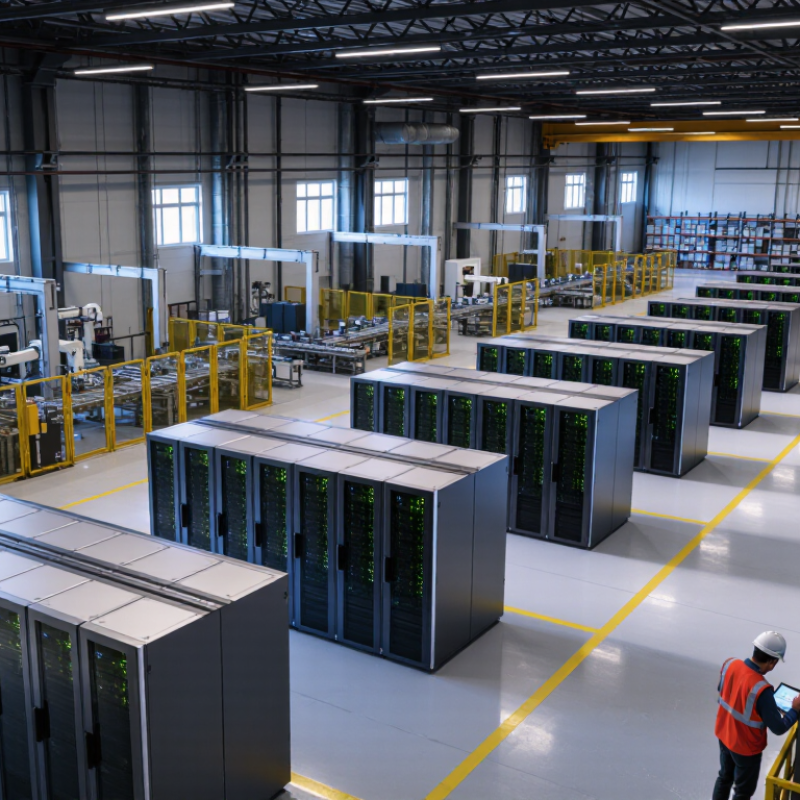
Top 10 Industrial AI Server Manufacturers Worldwide

Industrial AI Servers: Definition, Core Features, and Industrial Applications

Industrial AI servers are purpose-built computing systems for factories, energy sites, transport hubs, and other demanding environments. They process camera feeds, sensor readings, and machine data close to where events occur. Unlike ordinary office servers, they must operate reliably beside vibration, dust, heat, and unstable network connections. In practical deployments, edge processing can reduce latency from seconds to milliseconds. That difference matters when a robotic arm or conveyor needs an immediate response.

Core features include high parallel-processing capacity, industrial-grade components, redundant power, and wide temperature tolerance. Fast memory and storage support real-time analytics, while multiple network interfaces connect cameras, controllers, and sensors.

Hardware acceleration can run vision inspection, predictive maintenance, digital-twin simulations, and anomaly detection efficiently.

Security also deserves attention. Secure boot, encrypted storage, access controls, and regular firmware updates help protect operational data.

Cooling design is often overlooked. A server that performs well in a laboratory may throttle inside a dusty production cabinet.

Applications vary by risk and workflow. A food-processing line may identify damaged packaging before shipment. A power facility can detect unusual vibration in rotating equipment. Logistics centers use AI servers to track parcels and optimize vehicle movement.

Yet deployment is rarely perfect. Poorly labeled data creates false alarms, and an impressive model may fail under new lighting or seasonal conditions.

Engineers should test accuracy, maintenance needs, and human override procedures on site. Some assumptions need rechecking. Reliable performance comes from measured trials, clear monitoring, and disciplined updates.

Criteria for Selecting the Top 10 Industrial AI Server Manufacturers

Selecting the top 10 industrial AI server manufacturers requires more than comparing processor counts. A credible evaluation should begin with plant experience, field maintenance records, and verified workload tests. IDC’s Worldwide AI and Generative AI Spending Guide projects global AI spending will surpass 600 billion dollars by 2028. This growth increases the need for servers that deliver stable performance, not impressive specifications alone.

Thermal design deserves close attention. Industrial facilities may face dust, vibration, unstable power, and limited cooling. A suitable manufacturer should provide validated operating ranges, redundant power options, remote diagnostics, and long-term component availability.

Uptime Institute’s 2024 Global Data Center Survey continues to identify power and cooling problems as major outage risks. Ask for measured failure rates. Marketing claims are not enough.

Energy efficiency must also shape the ranking. The International Energy Agency reports that data centers used about 415 terawatt-hours of electricity globally in 2024, with demand expected to rise sharply by 2030. Compare performance per watt under real industrial workloads, including computer vision and predictive maintenance. Security matters too. Look for secure boot, firmware controls, access logging, and documented vulnerability response. Independent certifications can help, but certification alone cannot prove field reliability.

That is the uncomfortable part. A server may pass laboratory tests and still struggle beside a hot production line. Pilot deployments, transparent service-level data, and technician feedback should carry more weight than polished brochures. Availability of spare parts also deserves a score. Without it, a powerful server can become expensive idle equipment.

Global Profiles of the Top 10 Industrial AI Server Manufacturers

Global Profiles of the Top 10 Industrial AI Server Manufacturers

This global profile compares ten industrial AI server manufacturers through measurable capabilities, not marketing claims. IDC’s 2024 Worldwide AI and Generative AI Spending Guide estimated global AI infrastructure spending at about US$154 billion in 2024. That growth is reshaping factories, energy sites, laboratories, and transport networks. The leading North American profiles emphasize accelerated computing and software integration. Western European manufacturers focus on functional safety, energy efficiency, and long equipment lifecycles. East Asian suppliers often compete through dense production, rapid customization, and regional supply chains.

The ten profiles also reveal different engineering priorities. One manufacturer specializes in rugged edge servers for dusty plants. Another builds liquid-cooled systems for continuous industrial workloads. A third focuses on compact inference servers near robotic cells. Other profiles emphasize high-speed networking, remote management, redundant power, or validated industrial operating environments. Several manufacturers support modular GPU expansion, while others prioritize lower heat output and easier maintenance. Gartner reported that AI semiconductor revenue reached approximately US$71.3 billion in 2024, showing why accelerator compatibility matters in server selection. Yet performance claims require testing.

Public comparisons remain imperfect. Vendors disclose different power measurements, cooling conditions, and workload results. That weakens simple rankings. In practical evaluations, buyers should inspect cabinet temperature, acoustic levels, firmware update procedures, and replacement times. A fast server can still disappoint. The best profile depends on factory constraints, local support, and the cost of downtime.

Comparative Analysis of Products, Technologies, and Market Strengths

Top 10 Industrial AI Server Manufacturers Worldwide

The leading ten manufacturers compete through different product strategies, not identical specifications. Industrial buyers compare GPU density, thermal design, network speed, and lifecycle support. IDC forecast worldwide AI infrastructure spending would reach 154 billion dollars in 2024, rising 44.2% year over year. This growth favors vendors offering rack-scale systems, liquid cooling, and validated software stacks.

Product differences become clearer in factory environments. Some manufacturers prioritize compact edge servers for robotic inspection and predictive maintenance. Others build high-density platforms for digital twins, simulation, and large language model training. Systems with redundant power supplies, extended temperature ranges, and remote management usually fit plants better. Omdia reports that accelerated computing is reshaping data-center investment, but performance per watt remains a practical purchasing measure. A faster server can still lose when cooling costs overwhelm its throughput.

Market strength also depends on regional service networks, supply continuity, and open integration. IDC’s 2024 infrastructure research highlights strong demand for accelerated computing across cloud and enterprise deployments. However, industrial customers often need five-year support, not impressive benchmark results alone. That distinction is easy to miss. The strongest manufacturers typically provide validated drivers, industrial networking compatibility, and on-site replacement programs. Rankings remain imperfect because public revenue data combines servers, components, and services. Buyers should therefore test workloads using their own camera streams, sensor volumes, and maintenance schedules before selecting a supplier.

Industry Trends Shaping the Future of Industrial AI Servers

Top 10 Industrial AI Server Manufacturers Worldwide

Industrial AI servers are shifting from centralized data centers toward factory floors, ports, mines, and energy sites. This change is driven by real-time decisions. A production camera may inspect hundreds of parts each minute. Sending every image to the cloud can create costly delays.

The strongest manufacturers now focus on rugged design, modular accelerators, and efficient thermal control. Edge servers must survive dust, vibration, unstable temperatures, and limited network access. Specialized processors also support predictive maintenance, digital twins, and robotic vision. However, performance alone is not enough. Buyers should examine service life, cybersecurity updates, data governance, and compatibility with existing control systems. These details often decide whether a pilot becomes useful or abandoned.

Tips: Test servers with real factory data before large purchases. Measure response time, energy use, maintenance effort, and model accuracy. Keep a small offline mode. It matters.

From practical deployment experience, integration remains harder than installation. Older machines may use inconsistent protocols. Skilled workers may also distrust automated recommendations after one visible error. That concern is reasonable. Manufacturers need clearer diagnostics, human override functions, and traceable decisions. Industrial AI should assist operators, not hide uncertainty. A promising trend is liquid cooling for dense computing, yet maintenance demands may rise. More powerful hardware can solve one bottleneck while creating another.

Top 10 Industrial AI Server Manufacturers Worldwide

Industry Trends Shaping the Future of Industrial AI Servers

The chart compares representative forecast compound annual growth rates for technologies influencing industrial AI server demand. Growth is being driven by edge intelligence, accelerated computing, industrial IoT, machine vision, private 5G, digital twins, and energy-efficient data-center infrastructure.

Data reflects consolidated ranges reported in publicly available industry outlooks for approximately 2024–2029; forecast periods and market definitions may differ by category.

FAQS

What is driving growth in industrial AI server demand?

Global AI infrastructure spending reached about US$154 billion in 2024. Factories, laboratories, energy sites, and transport networks need faster analysis.

Which server features matter most in industrial environments?

Buyers should compare GPU density, thermal design, network speed, remote management, and lifecycle support. Redundant power can reduce interruptions.

Why is cooling important for industrial AI servers?

High-density systems generate substantial heat during continuous workloads. Liquid cooling may improve stability, but it can increase installation complexity.

Are compact edge servers useful near robotic production cells?

Yes. Compact servers can process camera feeds and sensor data close to machines. This may reduce network delays and cloud dependence.

How should buyers evaluate server performance?

Test the server with real camera streams, sensor volumes, and maintenance schedules. Public benchmarks can mislead. Testing matters.

What environmental conditions should industrial servers handle?

Some facilities need extended temperature ranges, dust resistance, and lower acoustic output. A clean laboratory test may not represent a factory floor.

Why do service and replacement programs matter?

Industrial buyers often require several years of support. Faster component replacement can reduce costly downtime. Local coverage still varies.

Is the fastest server always the best choice?

No. Cooling costs, power use, maintenance time, and software compatibility can change the result. A slower system may perform better overall.

Why are public manufacturer rankings imperfect?

Companies report power, cooling, and workload results differently. Revenue figures may combine servers, components, and services. Comparisons remain incomplete.

What should buyers confirm before selecting a supplier?

Confirm validated drivers, industrial networking support, firmware procedures, cabinet temperatures, and replacement times. The final decision needs practical testing.

Conclusion

Industrial AI servers are purpose-built computing systems designed to process complex data, run artificial intelligence models, and support real-time decision-making in demanding industrial environments. This article explains their definition, core features, and applications across manufacturing, energy, transportation, logistics, healthcare equipment, and other critical sectors. It also outlines the key criteria for selecting a reliable industrial ai server manufacturer, including processing performance, durability, thermal management, scalability, cybersecurity, software compatibility, lifecycle support, and overall cost efficiency.

The article presents a global overview of leading manufacturers without focusing on specific brand names, comparing their product capabilities, technology approaches, market coverage, and service strengths. It further examines major trends shaping the industry, such as edge computing, energy-efficient architectures, accelerated AI processing, industrial connectivity, modular design, and intelligent automation. Together, these insights help organizations understand how industrial AI servers can improve operational efficiency, strengthen predictive maintenance, and support the development of more flexible, secure, and data-driven industrial systems.

Henry

Henry

Henry is a dedicated marketing professional with a profound expertise in the company's offerings. With years of experience in the industry, he possesses an impressive understanding of the market dynamics and consumer behaviors that drive success. Henry is committed to sharing his insights through......