Cyntara Cyntara

What Is a Global AI Server Manufacturer?

Time:2026-09-30 Author:Aria
0%

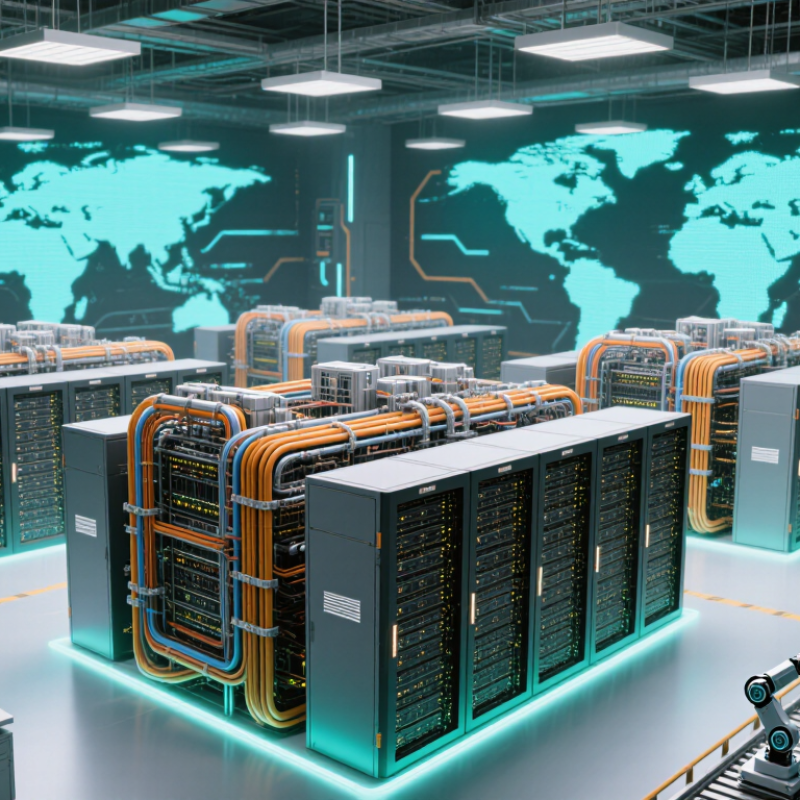
A global AI server manufacturer builds or integrates the systems that train and run artificial intelligence at scale. These machines combine GPU accelerators, high-bandwidth memory, fast networking, and carefully managed cooling. A rack may contain hundreds of processors, dense cabling, and liquid-cooling pipes. The work is more than assembling hardware. It also involves testing, software compatibility, supply-chain coordination, and dependable support across regions.

Demand is rising, but market figures need context. IDC’s Worldwide AI and Generative AI Spending Guide projected AI spending would reach $632 billion by 2028. Gartner separately forecast worldwide AI spending of $1.5 trillion in 2025. These are broad AI investment estimates, not server-sales totals. They still show why manufacturers are expanding capacity and competing on performance, energy use, and delivery times. The details matter.

At COMPUTEX 2024, NVIDIA founder and CEO Jensen Huang said, “The next industrial revolution has begun.” His remark captures the scale of the shift, though it does not explain what makes one supplier more capable than another. That distinction matters. Buyers must compare validated system performance, component availability, service coverage, and power requirements—not just headline GPU counts. “Not quite.” A large shipment record alone does not prove long-term reliability. The term global AI server manufacturers is also not perfectly standardized; companies differ in how much they design, manufacture, and integrate themselves. This guide examines what the label means, how leading suppliers operate, and which practical evidence helps separate global reach from marketing claims.
What Is a Global AI Server Manufacturer?

Defining Global AI Server Manufacturers Through IDC’s AI Infrastructure Taxonomy

What Is a Global AI Server Manufacturer?

Defining Global AI Server Manufacturers Through IDC’s AI Infrastructure Taxonomy

A global AI server manufacturer is more than a company that assembles rack equipment. IDC’s AI infrastructure taxonomy points toward a broader system: accelerated compute, high-bandwidth memory, storage, networking, software integration, and lifecycle support. A credible manufacturer must connect these layers into reliable deployments across regions. It should also understand local power limits, cooling conditions, data rules, and service expectations. The boundary is not perfectly clean.

IDC’s Worldwide AI and Generative AI Spending Guide projects global AI infrastructure spending to reach approximately $154 billion by 2028. That forecast reflects demand for dense systems, faster interconnects, and scalable data-center capacity. The International Energy Agency’s Electricity 2024 report also estimates that data-center electricity use could more than double by 2026, reaching over 1,000 terawatt-hours annually. Efficiency is no longer a minor specification.

Practical evaluation requires evidence. Look for documented performance under sustained workloads, thermal testing, component traceability, security controls, and regional support coverage. A manufacturer should explain how its systems handle model training, inference, and mixed enterprise workloads. It should publish measurable results, not only impressive peak figures. Even this framework has limits. AI platforms change quickly, and today’s ideal configuration may become inefficient sooner than expected. That uncertainty deserves honest reporting.

Core Components: GPUs, CPUs, Memory, Networking, and Cooling Systems

What Is a Global AI Server Manufacturer?
Core Components: GPUs, CPUs, Memory, Networking, and Cooling Systems

A global AI server manufacturer designs and builds systems that keep demanding workloads running across different data centers. The parts must work together, not just meet impressive specifications. GPUs perform parallel calculations, while CPUs coordinate tasks and manage data flow. Fast memory keeps model data close to processors; limited bandwidth can leave expensive computing resources waiting. Networking links servers, so its speed and latency affect how efficiently large jobs run. Heat is measurable. Cooling systems must remove it steadily, especially when racks operate at high power for long periods.

Tips: Check memory bandwidth, network capacity, and cooling design alongside processor performance. Ask how airflow moves through a loaded rack, not only an empty test unit. Small details matter.

In practical deployments, teams should validate performance under sustained workloads. A brief benchmark may miss temperature changes, power limits, or network congestion that appear after hours of operation. Monitoring temperatures and error rates can reveal issues early. Even careful designs involve trade-offs: stronger cooling may use more power, while denser configurations can complicate maintenance. The right balance depends on workload, room conditions, and service needs. A sound manufacturer documents these choices clearly and supports consistent testing.

What Is a Global AI Server Manufacturer?

Core components and estimated power draw in an illustrative 8-accelerator AI server

The chart shows approximate power allocations: eight accelerators at 700 W each, two CPUs at 350 W each, plus estimated memory, networking, and server-fan loads. Actual requirements vary by system design and workload; cooling refers to the server’s fans, not facility-level cooling.

Manufacturing Scale and Supply Chains Across Global Data-Center Markets

A global AI server manufacturer must coordinate more than assembly lines. It needs dependable supplies of processors, memory, networking parts, power systems, and cooling components. These parts may come from different regions, each with distinct shipping times and production limits. Scale matters, but flexibility matters too. A factory that can build several server configurations may respond faster when one component runs short.

The demand behind this work is growing quickly. The International Energy Agency’s Electricity 2024 report estimated that data centers, AI, and cryptocurrency used about 460 terawatt-hours of electricity in 2022. It projected that demand could exceed 1,000 terawatt-hours by 2026. Synergy Research Group counted more than 1,000 operational hyperscale data centers worldwide in 2024. These figures point to a market spread across regions, not one central destination. Manufacturers must manage local delivery, testing, and service alongside global procurement. A delayed shipment can leave a rack incomplete, even when most parts are ready. That detail is easy to underestimate. Scale alone does not guarantee resilience, and regional stockpiles can become costly or poorly matched to changing designs. Manufacturers still have to decide where buffers are worth the expense.

Measuring Performance with MLPerf, TDP, FLOPS, and Energy Efficiency

What Is a Global AI Server Manufacturer?

Measuring Performance with MLPerf, TDP, FLOPS, and Energy Efficiency

An AI server’s performance cannot be captured by one number. MLPerf results show how quickly a system handles defined training or inference workloads, but test settings matter. Compare the same model, precision, batch size, and software versions. Otherwise, a headline score can hide useful differences. Real workloads are messier.

TDP describes thermal design needs, not a direct reading of power drawn from the wall. FLOPS estimates computing throughput, yet high theoretical throughput does not guarantee faster results. Memory bandwidth, accelerator links, storage, and cooling can become bottlenecks. Watch the whole rack. Measure energy per completed task under a consistent workload.

For example, record kilowatt-hours while processing a fixed set of image requests, then note latency and failed jobs.

A global manufacturer should provide reproducible measurements across regions, along with clear test methods and service documentation. Ask whether published figures include host processors, fans, and power conversion losses. Those details change comparisons. Also check performance at realistic utilization; idle capacity still uses power. Not perfect. No benchmark reflects every data center, and cooling varies by site. Treat MLPerf, TDP, FLOPS, and energy efficiency as complementary evidence, then test the server with your own workload before sizing a cluster.

Market Structure: OEMs, ODMs, and Platform Vendors in Gartner’s Industry Data

A global AI server manufacturer can occupy several positions in the supply chain. OEM, ODM, and platform vendor describe different roles, not three cleanly separated factory types. Gartner’s server-market data helps compare suppliers by revenue and market share. It does not, by itself, show who designed a server board or assembled a rack. That distinction matters when interpreting AI-server rankings.

IDC’s Worldwide Quarterly Server Tracker reported global server revenue of $77.3 billion in the fourth quarter of 2024, up 91.9% year over year. The sharp rise reflects demand for AI infrastructure, but revenue alone cannot identify a supplier’s exact role. OEMs typically sell complete systems under their own names. ODMs design or manufacture systems for other sellers, often at scale. Platform vendors shape validated combinations of processors, accelerators, networking, and software. The lines blur.

On a factory floor, the difference may show up in who specifies a power shelf, tunes airflow, or tests a rack before shipment. A platform vendor may define the configuration, while an ODM builds it and an OEM handles customer support. These arrangements can overlap. Market datasets rarely capture every contract relationship, so readers should treat category labels as useful clues, not a full map of manufacturing responsibility.

What Is a Global AI Server Manufacturer? — Market Structure: OEMs, ODMs, and Platform Vendors in Gartner’s Industry Data
Market participant type Primary role Typical design responsibility Manufacturing and integration role Typical customer relationship Useful industry-data dimensions
Original equipment manufacturer (OEM) Supplies server systems under its own product identity and is generally accountable for the system’s specification, validation, support, and product lifecycle. Usually defines or controls the system-level design, including platform configuration, firmware requirements, and qualification of components. May manufacture directly, outsource some or all production, or combine internal and external manufacturing. The exact model varies by supplier. Often sells through direct enterprise channels, distributors, solution providers, or cloud and data-center procurement teams. System shipments; server revenue; processor architecture; accelerator configuration; form factor; customer segment; geography; support and services attachment.
Original design manufacturer (ODM) Designs and manufactures systems or subsystems that may be sold directly to large buyers or supplied for another organization’s product portfolio. Typically contributes hardware engineering and platform design, often adapting designs to customer specifications and deployment requirements. Provides manufacturing, assembly, and related supply-chain capabilities. The scope of integration can range from components to complete rack-scale systems. Frequently serves large-scale data-center operators, cloud service providers, and other high-volume buyers; customer arrangements are contract-specific. Design-and-manufacturing revenue; systems or racks delivered; customer type; manufacturing location; product configuration; direct versus indirect sales.
Platform vendor Provides a validated hardware-and-software platform or reference architecture for AI infrastructure; it is a role in the ecosystem rather than a single manufacturing model. May define supported component combinations, system architecture, firmware, software stack, and interoperability requirements. May manufacture systems, license or supply platform components, or work with OEMs and ODMs that build and deliver validated systems. Engages with system suppliers, software providers, data-center operators, and enterprise buyers to support deployment and compatibility. Platform availability; supported accelerator and network configurations; validated system designs; ecosystem coverage; software compatibility; deployment scale.
Role overlap and classification One organization can perform more than one role—for example, designing a platform while also selling branded systems or providing contract manufacturing. Responsibilities should be classified by activity and product, rather than assuming that each organization belongs to only one category. Manufacturing location, design ownership, system integration, and sales channel are distinct attributes and should be recorded separately. Channel structure and customer type can differ across product lines and regions. Use separate fields for role, shipment or revenue measure, product scope, geography, reporting period, and source definition.
Interpreting Gartner industry data Market reports may define vendors, products, and market boundaries differently depending on the report and its stated methodology. Do not treat OEM, ODM, and platform vendor as universally exclusive categories unless the specific report defines them that way. Shipment, revenue, and production-capacity figures are not interchangeable; compare only when scope, period, and measurement basis match. Check whether a figure covers end-user sales, supplier revenue, contract manufacturing, or another stated measure. This table describes common industry roles and data fields. It does not present company rankings, market shares, or figures attributed to a specific Gartner report.

FAQS

Can one number fully describe an AI server’s performance?

No single number is enough. Benchmark results show speed under defined workloads, not every real deployment.

What should be matched when comparing benchmark results?

Match the model, precision, batch size, and software versions. Otherwise, the comparison may look better than it is.

Does TDP equal the server’s actual wall power?

No. TDP describes thermal design needs. Measure wall power directly, including fans and power conversion losses.

Does higher FLOPS always mean faster results?

Not always. Memory bandwidth, accelerator links, storage, and cooling can limit performance.

How can teams measure practical energy efficiency?

Process a fixed workload and record kilowatt-hours, latency, and failed jobs. Small details matter.

What should a global AI server manufacturer disclose?

It should provide repeatable regional measurements, test methods, and service documents. Clear details build trust.

How do OEMs, ODMs, and platform vendors differ?

OEMs usually sell complete systems. ODMs design or build systems for others. Platform vendors validate hardware and software combinations.

Can one company perform several supply-chain roles?

Yes. Roles often overlap. One company may define configurations, another may build racks, and another may provide support.

Do market revenue rankings reveal who built a server?

Not necessarily. Revenue shows market position, but it may not reveal board design or factory responsibility.

Should benchmark data alone determine cluster size?

No. Test your own workload before purchasing. Cooling differs by site, and idle hardware still consumes power.

Conclusion

Global ai server manufacturers design and produce systems built to support artificial intelligence workloads in data centers. Their products combine GPUs for parallel computation, CPUs for general processing, high-capacity memory, fast networking, and cooling systems that manage heat under sustained demand. A useful way to understand this field is to classify servers by the infrastructure tasks they support, such as model training, inference, or data processing, while considering how each component contributes to system performance.

Manufacturing at global scale depends on coordinating suppliers, assembly, testing, and delivery across regions with different data-center needs. Buyers can compare systems using measures such as MLPerf results, thermal design power (TDP), FLOPS, and energy efficiency, but these figures should be viewed together rather than in isolation. The market also includes companies that sell complete systems, firms that manufacture designs for other vendors, and platform providers that combine hardware with supporting technologies. These roles shape how AI server solutions are developed, supplied, and deployed.

Aria

Aria

Aria is a dedicated marketing professional with a deep passion for innovative strategies and a keen understanding of our company's product offerings. With a wealth of experience in the industry, Aria excels at crafting engaging content that highlights the unique features and benefits of our......